

Overview
Role:
Design Lead
Duration:
Jan - Aug 2026
Contribution:
User Research, UI/UX Design, Design System
Context
A security incident can quickly turn into hours of investigation.
Every Incident Has a Story to Uncover
On an enterprise campus, incidents can range from a person brandishing a firearm to tailgating or loitering.
Once an incident happens, operators need to answer:
❓ What happened?
📍 Where and when did it happen?
🗺️ Where else did this person go?
Long Process, Time Consuming.
With traditional security tools, answering these questions means searching footage, jumping between cameras, exporting clips, and manually assembling the story. What should be a single investigation becomes a fragmented, hours-long process.

Problem
01- Investigation is fragmented across tools
Investigation workflow is disconnected
During a customer site visit, we observed security operators using multiple tools to investigate a single incident. Operators had to manually move evidence and context between systems.
🔔 Ambient
Alert Incident with location and camera details
🎞️ Milestone
Find incident evidences and export video footage
🗂️ CCure
Log incident info and share case with stakeholders
02 — Investigations start from different clues
Investigations start from different clues
The entry point may change, but the goal is the same: reconstruct the incident.
💭 I know what the suspect looks like
A rough description of the suspect, e.g. a person wearing black hoodie.
📸 I have a photo
An image of the suspect, but not enough context.
🎞️ I found them on a camera
A known location, but no visibility into where they went next.

Ideation
From Clue to Case — On a Single Pane of Glass

Natural Language Search
Turn any clue into a searchable lead.
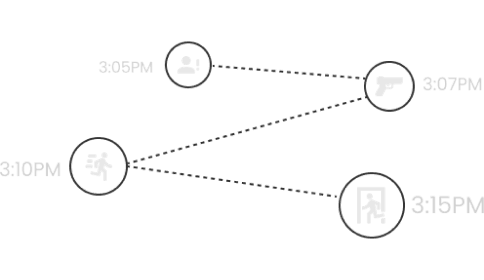
Chronologic Evidence
Turn search results into a organized story.

Case Package
Turn incident evidence into a case to share.
Design
1 - Starting Point
Search
Natural language search
Image upload Search
Search from Camera
2 - Collect Evidence
Filter and Identify Search Results
Add relevant evidences to timeline, auto-organize chronologically.
Save as Case
3 - Organize and Share it
Manage evidence and Report Case
Case Management Overview

Case Sharing
Next Step
Badge ID / License Plate Search
Badge ID Search

License Plate Search

Impact
20× faster investigations and case filing
Launched in August and already adopted by early customers, the feature turns a fragmented, hours-long workflow into a continuous experience — helping operators go from clue to case 20× faster.
Reflection
This project pushed me to think about how search, video, evidence, and case management could work as one cohesive experience rather than a collection of tools. I focused on preserving context as operators move from one step to the next, while keeping the workflow flexible enough to support different investigation starting points.
Good workflow design isn’t about adding more capabilities. It’s about making complex work feel continuous.