Geolocation Intelligence
Geolocation Intelligence
Geolocation Intelligence
Enabling real-time spatial awareness for security operations
Enabling real-time spatial awareness for security operations
Enabling real-time spatial awareness for security operations
Team:
Team:
Team:
1 Product Manager
1 Product Manager
1 Product Manager
1 Product Designer
1 Product Designer
1 Product Designer
2 Software Engineer
2 Software Engineer
2 Software Engineer
Timeline:
Timeline:
Timeline:
6 weeks
6 weeks
6 weeks
2025 Q4
2025 Q4
2025 Q4
Production
Production
Production
Contribution:
Contribution:
Contribution:
Design Roadmap
Design Roadmap
Design Roadmap
Visual Design
Visual Design
Visual Design
Interaction Design
Interaction Design
Interaction Design
Design & Impact
Design & Impact
Design & Impact
As the sole designer, I drove the product from early research through execution, defining a four-phase roadmap and delivering key experiences across onboarding, camera management, and alert response in close collaboration with cross-functional teams.
As the sole designer, I drove the product from early research through execution, defining a four-phase roadmap and delivering key experiences across onboarding, camera management, and alert response in close collaboration with cross-functional teams.
As the sole designer, I drove the product from early research through execution, defining a four-phase roadmap and delivering key experiences across onboarding, camera management, and alert response in close collaboration with cross-functional teams.
12k+
12k+
12k+
Cameras Mapped
Cameras Mapped
Cameras Mapped
18%
18%
18%
Time-to-resolve Reduction
Time-to-resolve Reduction
Time-to-resolve Reduction
26
26
26
Customer Production
Customer Production
Customer Production
Highlights
Highlights
Highlights
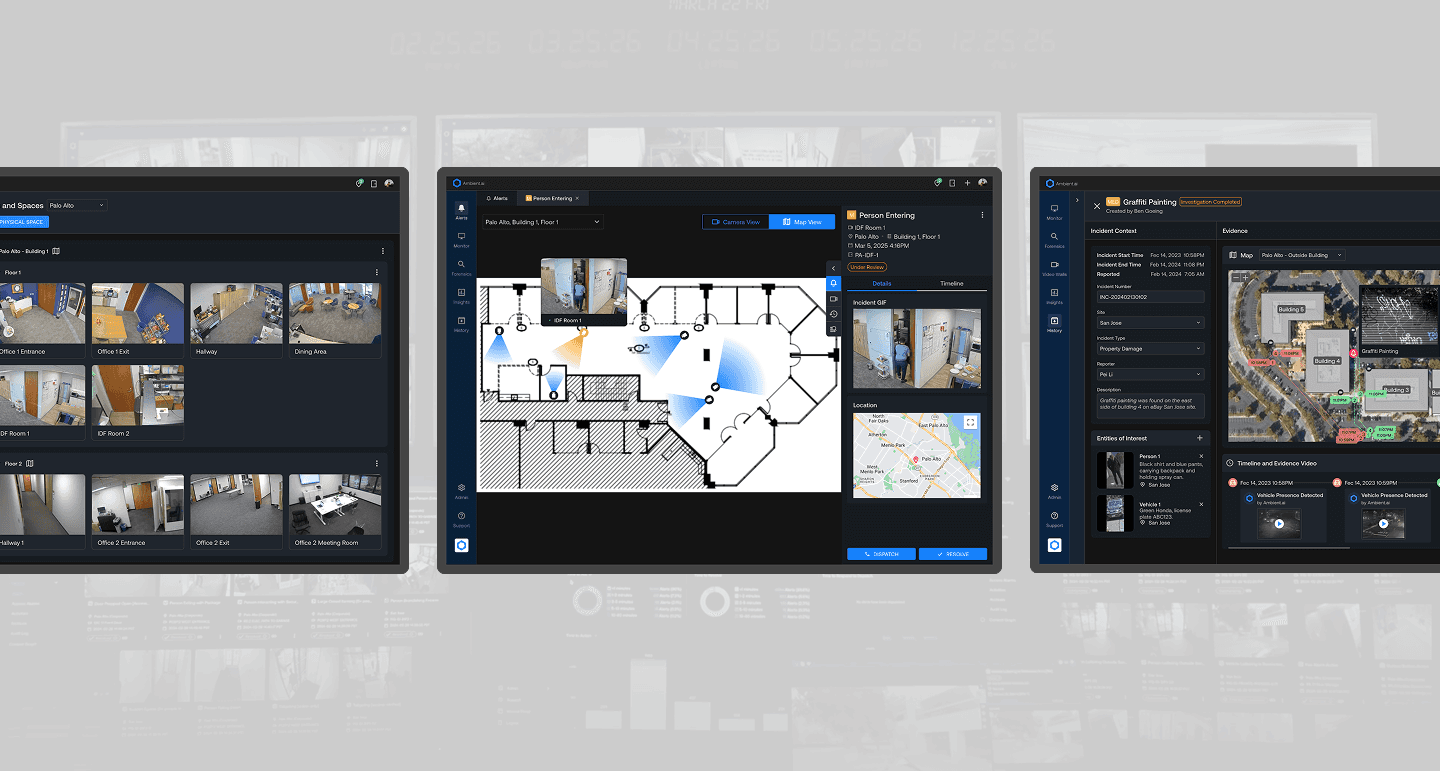
Map Controls
Map Controls
Camera Field of View Adjustment
Camera Field of View Adjustment
Alert Geolocation
Alert Geolocation
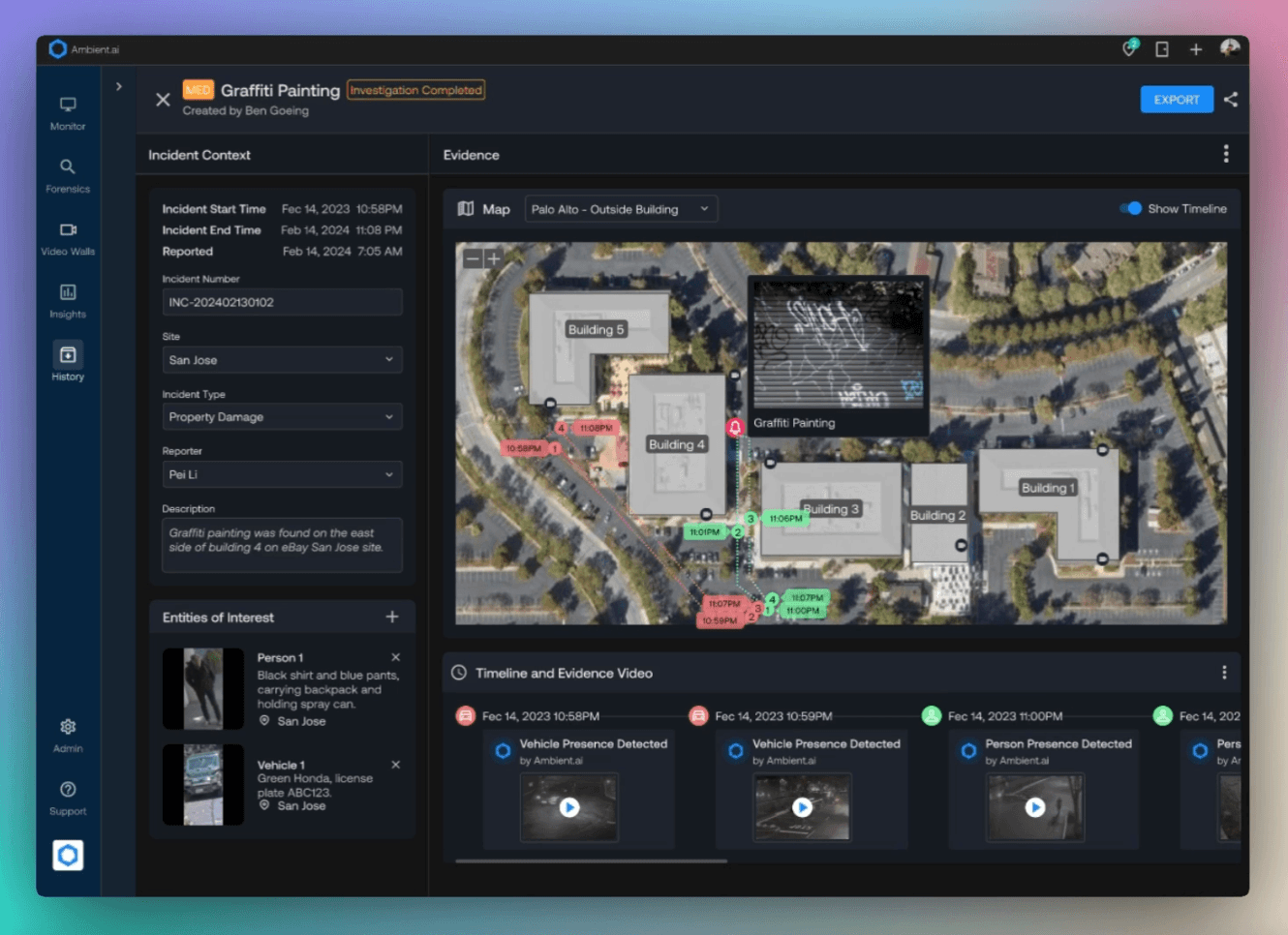
Mapping Timeline in Case Management
Mapping Timeline in Case Management
Context
Context
Context
Background
Background
Background
Ambient AI is a security platform powered by computer vision and vision-language models. Security operators use the system to monitor cameras, investigate incidents, and respond to real-time alerts.
Ambient AI is a security platform powered by computer vision and vision-language models. Security operators use the system to monitor cameras, investigate incidents, and respond to real-time alerts.
Ambient AI is a security platform powered by computer vision and vision-language models. Security operators use the system to monitor cameras, investigate incidents, and respond to real-time alerts.
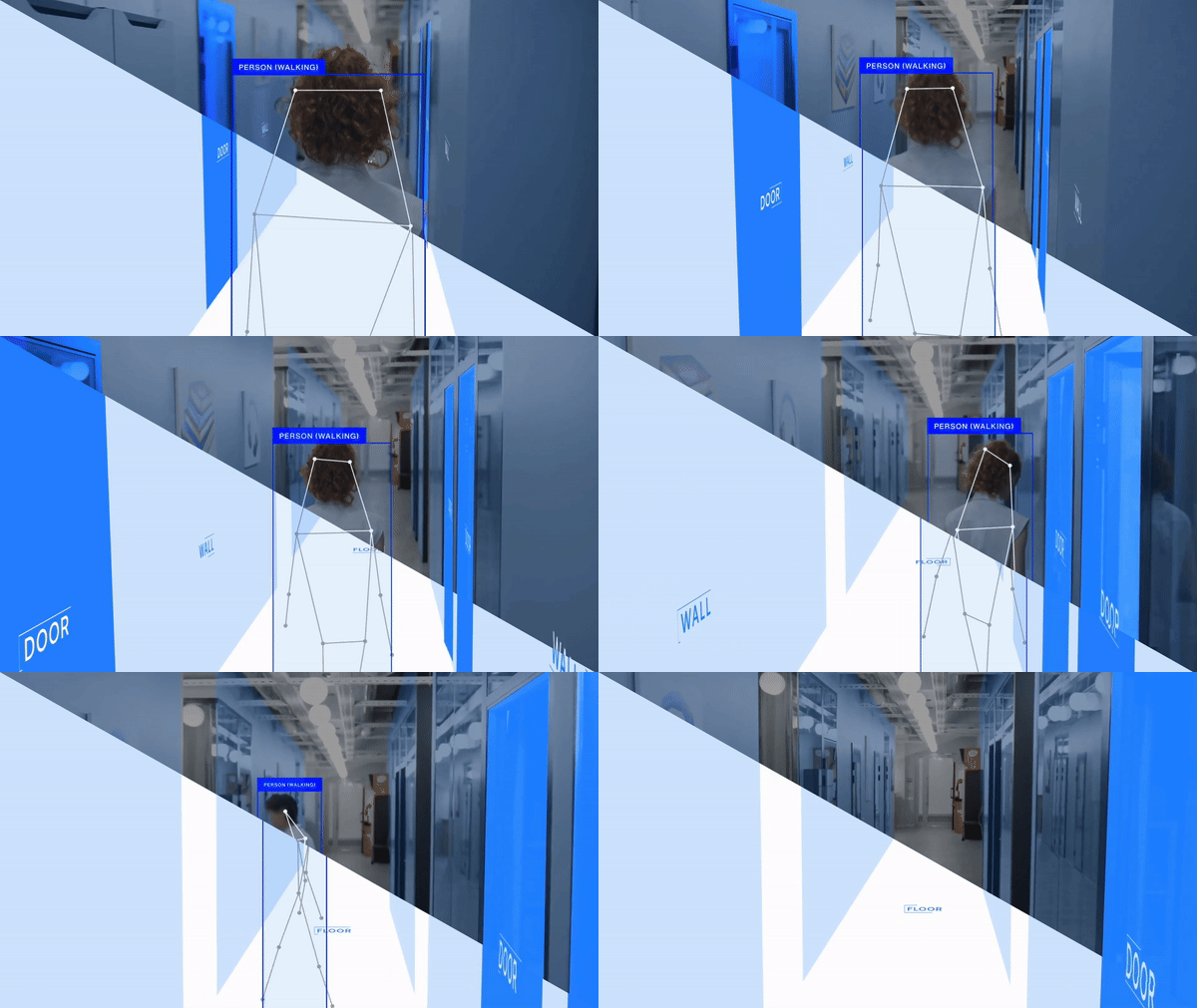
what AI sees
what AI sees
vs.
vs.
what human sees
what human sees
Persona & Pain Points
Persona & Pain Points
Persona & Pain Points
Security operators monitor camera networks and investigate alerts, while responders handle incidents on-site. Their biggest challenge is not knowing the exact location of a camera or alert, which slows response and reduces operational efficiency.
Security operators monitor camera networks and investigate alerts, while responders handle incidents on-site. Their biggest challenge is not knowing the exact location of a camera or alert, which slows response and reduces operational efficiency.
Security operators monitor camera networks and investigate alerts, while responders handle incidents on-site. Their biggest challenge is not knowing the exact location of a camera or alert, which slows response and reduces operational efficiency.
Design Goal
Design Goal
Design Goal
Product Roadmap & Design Objectives
Product Roadmap & Design Objectives
This project focused on mapping cameras and geolocating alerts, two key milestones within a broader four-step roadmap.
This project focused on mapping cameras and geolocating alerts, two key milestones within a broader four-step roadmap.
This project focused on mapping cameras and geolocating alerts, two key milestones within a broader four-step roadmap.
🗂️ 1. Organize Spaces (2024 Q3-Q4)
🗂️ 1. Organize Spaces (2024 Q3-Q4)
🗂️ 1. Organize Spaces (2024 Q3-Q4)
Create a structure to group adjacent cameras for clearer spatial understanding
Create a structure to group adjacent cameras for clearer spatial understanding
📍 2. Camera Mapping
📍 2. Camera Mapping
📍 2. Camera Mapping
Place cameras and adjust field of view on a visual map for easier navigation
Place cameras and adjust field of view on a visual map for easier navigation
🔔 3. Alert Geolocation
🔔 3. Alert Geolocation
🔔 3. Alert Geolocation
Show alert locations and dispatch the nearest responder to improve time-to-resolve
Show alert locations and dispatch the nearest responder to improve time-to-resolve
🔎 4. Case Management (2026 Q2-Q4)
🔎 4. Case Management (2026 Q2-Q4)
🔎 4. Case Management (2026 Q2-Q4)
Collect and display incident evidence on the map for case management
Collect and display incident evidence on the map for case management
Features
Features
Features
1 Uploading a floor plan
1 Uploading a floor plan
Based on the physical space hierarchy, users can upload floor plans at the floor level, creating a structured foundation for camera placement and spatial awareness.
Based on the physical space hierarchy, users can upload floor plans at the floor level, creating a structured foundation for camera placement and spatial awareness.
Based on the physical space hierarchy, users can upload floor plans at the floor level, creating a structured foundation for camera placement and spatial awareness.
2 Map View Controls
2 Map View Controls
Interactive controls—including zoom, reset, and fit-to-window—along with a mini-map enable seamless navigation of complex floor plans.
Interactive controls—including zoom, reset, and fit-to-window—along with a mini-map enable seamless navigation of complex floor plans.
Interactive controls—including zoom, reset, and fit-to-window—along with a mini-map enable seamless navigation of complex floor plans.
3 Camera Placement and Management
3 Camera Placement and Management
Drag-and-drop camera placement with adjustable fields of view allows users to efficiently configure and oversee spatial coverage.
Drag-and-drop camera placement with adjustable fields of view allows users to efficiently configure and oversee spatial coverage.
Drag-and-drop camera placement with adjustable fields of view allows users to efficiently configure and oversee spatial coverage.
* Edge Case: Replace / Delete Floor Plan
* Edge Case: Replace / Delete Floor Plan
Users can choose whether to retain mapped cameras when replacing a floor plan, preserving positions or remapping them as needed.
Users can choose whether to retain mapped cameras when replacing a floor plan, preserving positions or remapping them as needed.
Users can choose whether to retain mapped cameras when replacing a floor plan, preserving positions or remapping them as needed.
4 Alert Geolocation and Response
4 Alert Geolocation and Response
Drag-and-drop camera placement with adjustable fields of view allows users to efficiently configure and oversee spatial coverage.
Drag-and-drop camera placement with adjustable fields of view allows users to efficiently configure and oversee spatial coverage.
Drag-and-drop camera placement with adjustable fields of view allows users to efficiently configure and oversee spatial coverage.
Next Step [Vision Design]
Next Step [Vision Design]
Next Step [Vision Design]
In Q2–Q3 2026, we plan to enhance case management by visualizing the full timeline of each incident case on the map. This will allow security operators to see all collected evidence in context, making it easier to review and understand each case.
In Q2–Q3 2026, we plan to enhance case management by visualizing the full timeline of each incident case on the map. This will allow security operators to see all collected evidence in context, making it easier to review and understand each case.
In Q2–Q3 2026, we plan to enhance case management by visualizing the full timeline of each incident case on the map. This will allow security operators to see all collected evidence in context, making it easier to review and understand each case.
Retrospective
Retrospective
Retrospective
⚖️ Balancing Complexity and Usability
⚖️ Balancing Complexity and Usability
⚖️ Balancing Complexity and Usability
Working on camera placement and map interactions showed me how to build powerful features that remain clear and intuitive.
Working on camera placement and map interactions showed me how to build powerful features that remain clear and intuitive.
Working on camera placement and map interactions showed me how to build powerful features that remain clear and intuitive.
🔁 End-to-End Ownership
🔁 End-to-End Ownership
🔁 End-to-End Ownership
Leading the project from research to implementation taught me how holistic thinking and cross-team collaboration drive meaningful results.
Leading the project from research to implementation taught me how holistic thinking and cross-team collaboration drive meaningful results.
Leading the project from research to implementation taught me how holistic thinking and cross-team collaboration drive meaningful results.
📈 Impact Through Metrics
📈 Impact Through Metrics
📈 Impact Through Metrics
The 18% reduction in time to resolve showed how introducing geolocation can directly improve operational efficiency. Tracking this metric helped validate the design decisions behind the floor plan experience. It also reinforced the importance of using data to measure impact and guide future iterations.
The 18% reduction in time to resolve showed how introducing geolocation can directly improve operational efficiency. Tracking this metric helped validate the design decisions behind the floor plan experience. It also reinforced the importance of using data to measure impact and guide future iterations.
The 18% reduction in time to resolve showed how introducing geolocation can directly improve operational efficiency. Tracking this metric helped validate the design decisions behind the floor plan experience. It also reinforced the importance of using data to measure impact and guide future iterations.